
Why Digital Literacy Is Now Essential for Learning English
English class doesn't end when the lesson does. It follows you onto your phone, into your inbox, and across the apps you use every day.
That changes everything about how people learn. Digital literacy and English learning now go together, because so much reading, writing, listening, speaking, and even staying safe happens online.
If you want stronger English, it helps to get better with the tools that carry it.
How digital literacy supports English learning in everyday life
Digital literacy helps because it turns English practice into part of daily life. You are not waiting for a textbook or a weekly lesson. You are reading messages, watching videos, using maps, filling out forms, and hearing spoken English in real situations.
A learner with basic digital skills gets more chances to practice. A learner without them misses those chances, even if motivation is high.
Using apps, websites, and videos to build reading, listening, and vocabulary
Phones and laptops are full of English input. Language apps, news sites, subtitles, podcasts, short videos, and online articles all give learners steady exposure to real words and real sentence patterns.
That matters because repetition is how language sticks. You can replay a podcast, pause a video, turn captions on, look up a word, and hear its pronunciation in seconds. If a sentence feels too hard, many tools offer examples, pictures, or translation support right away.
This kind of practice also feels more natural. You might read a product review, listen to directions, or watch a recipe video in English. That is study time, but it doesn't always feel like study. It feels like life.
Digital tools can also turn almost any screen into a stronger reading environment. With subtitles, translation support, audio playback, saved words, and search tools, learners can slow down difficult content and understand more of what they read.
If you can search, read, click, type, and reply with confidence, you can practice English all day, not only in class.
Communicating in English through chats, email, and online classes
A lot of English communication now happens on screens. Students join Zoom lessons, send messages in class groups, answer emails, and leave comments in shared documents. Workers do the same thing with teams, managers, and clients.
That means digital literacy is part of communication skills. Learners need to know how to type clearly, reply to the right person, mute and unmute in a video class, and follow basic online manners. Even simple habits, like writing a clear subject line or reading a message before sending it, improve English use.
Online spaces also give shy learners a different path. Some people speak more freely in a chat box first. Others build confidence with voice notes before live conversation. Digital tools create smaller, safer steps into real English.
Digital literacy is part of English fluency now
Fluency is not only about grammar and pronunciation. It is also about using English where real life happens. Right now, a huge share of that life is online.
That is why digital literacy now fits naturally into any modern English language arts curriculum. Students are not only learning how to read, write, listen, and speak. They’re also learning how to use those skills across websites, apps, emails, documents, and online learning platforms.
When learners can handle digital spaces well, they keep up in school, work, and daily tasks. When they cannot, English becomes harder than it needs to be.
Most English content, learning tools, and job tasks are online
English learners see online content all the time. Homework is posted on learning platforms. Job applications ask for uploads, passwords, and email verification.
Without digital skills, even a strong learner can get stuck. The problem may not be the language itself. The problem may be knowing where to click, how to open a document, or how to submit a form correctly.
That gap can slow progress fast. Missing one message can mean missing an assignment. Not understanding an online job form can mean missing an opportunity.
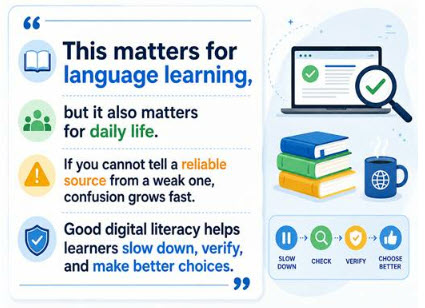
Digital literacy helps learners think clearly and avoid bad information
The internet is useful, but it is messy. Not every website explains English well. Not every video is accurate. Some pages are outdated. Some are built to sell, not teach.
Learners need simple habits for checking quality. Read headings first. Look at the date. Compare two or three results. Ask whether the explanation is clear, consistent, and written by a source you trust.
It also protects privacy and keeps learners safe online
Feeling safe online changes how willing people are to participate. If every message feels risky, learners hold back. If they know how to protect themselves, they use English more freely.
The basics are not complicated. Use strong passwords. Watch for fake links. Don't share personal details with strangers, and be careful with public posts.
Safety builds confidence. Confidence leads to more practice. That is one reason digital literacy is not a side topic anymore.
The digital skills English learners should practice now
The good news is that no one needs to become a tech expert overnight. Small habits go a long way, and they improve both language learning and daily communication.
Start with the skills you will use every week. Those are the ones that make the biggest difference.
Searching smarter and choosing the right English sources
Search is a language skill now. Learners who search well find better examples, clearer explanations, and faster answers.
A smart search often starts with better wording. Instead of typing one word, try a short question or phrase. If you want grammar help, add terms like "example sentence" or "difference between." Then scan the results instead of opening the first link blindly.
Good source choice matters too. Look for recent pages, plain explanations, and examples that sound natural. If three sources say the same thing, that's a good sign. If one page sounds strange, move on.
