
Top Mainframe Modernization Providers for Cloud Migration
"Let's move the mainframe to the cloud" is one of those sentences that sounds fine in a strategy meeting and terrifying to whoever actually has to execute it. Cloud migration itself isn't new. Companies have been moving web apps and databases for a decade now without much drama. The mainframe part is what changes everything, because you're not lifting and shifting a workload, you're untangling forty years of batch jobs and business logic that mostly lives in one guy's head, and he retired two years ago.
There's also no single "cloud migration" here. Rehosting, replatforming, refactoring, hybrid setups that keep core processing on-prem while everything else moves to AWS or Azure — which one's right depends entirely on what the system does and how much risk your org can actually stomach, whether anyone admits that out loud or not. Picking a provider basically means picking an approach, even if it doesn't feel that way at the start.
Quick aside before getting into companies: Recode is worth a look if you haven't used it. It's set up for comparing contractors across modernization and migration work, which beats cold-emailing five vendors and hoping one of them is honest about their timeline.
Here's who's doing solid mainframe-to-cloud work right now.
1. Corsac Technologies
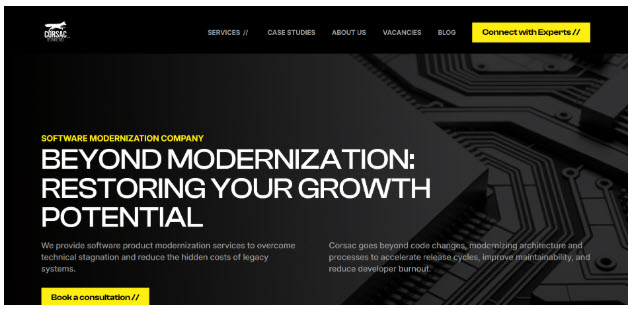
Most mainframe cloud migrations stall at the same spot: nobody's fully confident they understand every dependency the old system has, so nobody wants to be the one who signs off on the plan. That's the exact problem Corsac built its process around.
Their AI-driven modernization approach maps dependencies and pulls out business logic before migration planning even starts. Which sounds like a small thing until you realize it means the cloud architecture gets designed around what the system actually does, not around a decade-old wiki page nobody's updated. That upfront work is usually the difference between a migration that stays on schedule and one that keeps turning up "surprises" six weeks in.
Website: corsactech.com
2. Reliqsy
Reliqsy starts from similar ground, AI-assisted code analysis, but puts more weight on validation. Engineers use the AI output to flag technical debt early, then carry that into migration planning with the goal of keeping system behavior consistent once things actually move to the cloud.
That's a bigger deal than it sounds. A migration that "works" but quietly changes how the system handles some edge case is still a failure. It's just a slower, more expensive one to notice. Reliqsy pairing automated analysis with actual engineer validation is aimed squarely at catching that before it becomes a production incident.
Website: reliqsy.com
3. IBM
IBM's version of this story leans hybrid rather than full exit, which makes sense given they built the platform in the first place. Red Hat OpenShift and IBM Z integration tooling let z/OS workloads stay put while cloud-native pieces (APIs, containerized services, whatever actually benefits from cloud elasticity) grow up around them.
If your org isn't ready to leave the mainframe entirely, or doesn't really need to, IBM's hybrid path is often more realistic than whatever timeline a full-migration vendor is promising you.
Website: ibm.com
4. Kyndryl
Kyndryl's angle is Kyndryl Bridge, which brings AIOps into hybrid environments spanning mainframe, AWS, and Azure. The pitch isn't just "we'll move your workloads." It's "we'll make sure you can actually see what's happening once they're there," which matters more than people expect once the migration excitement wears off and someone has to keep an eye on a much more complicated environment every day.
Website: kyndryl.com
5. CGI
CGI's approach is more tool-heavy than most. Their M8 automated modernization environment targets Unix and Linux as the landing zone, with a focus on preserving core business processes while cutting the operational baggage mainframes tend to carry along with them. Their Global Competency Center backs it with dedicated teams built for large portfolio moves specifically.
Makes sense if you're aiming for meaningfully lower operating costs and you're comfortable leaving IBM Z behind entirely rather than staying hybrid.
Website: cgi.com
6. HCLTech
HCLTech goes incremental — "business capability first" is basically their whole philosophy, modernizing piece by piece instead of one big cutover. Their accelerators and AI-driven code analysis cut down manual effort in rehosting or refactoring work, while staying focused on functional parity so the migrated system still behaves like the old one did.
Reasonable pick for large, messy environments where a phased approach is less about being cautious and more about there just being a lot to move.
Website: hcltech.com
7. Astadia
Astadia sticks to cloud-ready replatforming and refactoring specifically, with Amdocs behind them for scale when a project needs it. FastTrack, their methodology, pairs with GenAI-assisted tooling and automated testing to try to shorten what's usually a multi-year mainframe-to-cloud slog, without skipping validation to get there.
They also work across a few cloud partners (AWS included), so you're not locked into one vendor's roadmap from day one.
Website: astadia.com
Picking the right one
There isn't really a clean "best for cloud migration" answer, and honestly I'd be a little suspicious of anyone who gives you one before knowing your system. Corsac and Reliqsy make the most sense when the real blocker is understanding an undocumented system before migration planning even starts. IBM and Kyndryl fit better if you're going hybrid and the mainframe isn't leaving anytime soon. CGI, HCLTech, and Astadia are worth a look for bigger, more complete moves off the platform.
Get two or three of these on a call before deciding anything. Ask how they actually handle dependency mapping and post-migration validation, not the general version of their pitch deck. Recode is a reasonable place to start lining those up before you commit to a scope.
