
The New Era of Content Verification: Why AI Detection Matters in Digital Communication
Artificial intelligence has transformed how information is created, edited, and distributed across the internet. From educational assignments and business reports to marketing campaigns and online publications, AI-powered writing tools have become part of everyday content workflows.
What once required hours of research, drafting, and editing can now begin with a simple instruction entered into an AI writing assistant. These advancements have made content creation more accessible, but they have also introduced new questions about authenticity, transparency, and responsible AI use.
As AI-generated content becomes increasingly common, identifying how written material was produced has become an important consideration for educators, publishers, businesses, and digital professionals.
This growing interest has encouraged the development of AI checker tools that analyze text and estimate whether it may have been generated using artificial intelligence.
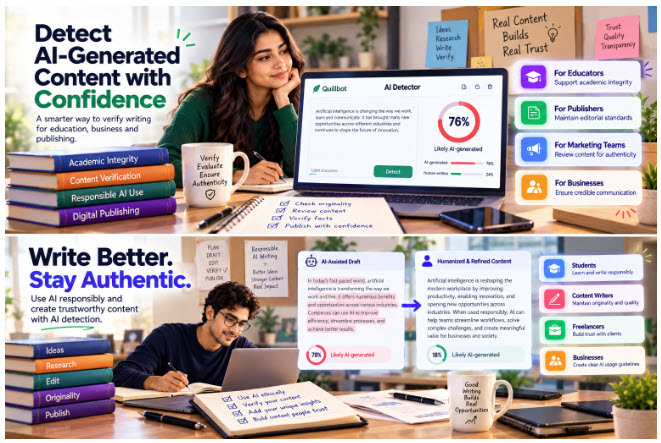
Solutions such as Quillbot AI Detector are helping users examine written content more critically, supporting a broader approach to content evaluation and responsible digital communication.
Understanding the Growing Need for AI Content Verification
The internet has always contained information of varying quality and reliability.
However, generative AI has made it possible to produce large volumes of written content quickly, creating new challenges for individuals and organizations responsible for reviewing published material.
An article may appear professionally written without necessarily providing accurate information. A research summary may include convincing explanations while overlooking important limitations. A business report may contain polished language but still require substantial factual verification.
These challenges highlight an important distinction: well-written content is not automatically trustworthy content.
Content verification involves examining several aspects of a document, including factual accuracy, source credibility, originality, transparency, and adherence to relevant editorial standards.
AI detection can contribute to this process by providing an additional perspective on possible AI involvement.
However, an AI detection result does not establish whether a document is accurate, plagiarized, ethical, or suitable for publication.
These questions require separate evaluation.
How AI Detection Technology Works
AI detection tools use computational models to examine patterns within written text.
These patterns may include sentence construction, word choice, linguistic predictability, and other statistical characteristics.
The objective is to identify whether the text resembles patterns associated with AI-generated writing.
For example, a document containing highly consistent sentence structures and predictable phrasing may exhibit characteristics associated with some AI-generated content.
However, similar characteristics can also appear in human writing.
Technical documentation, formal academic writing, and standardized business communication may contain repetitive or highly structured language.
This overlap explains why AI detection results should be interpreted cautiously.
No AI detector can reliably establish authorship in every situation.
The output is best understood as a probabilistic assessment rather than definitive evidence.
1. Education: Encouraging Responsible Academic Writing
Educational institutions have been among the most active participants in discussions about generative AI and content authenticity.
Students now have access to tools that can help explain concepts, summarize material, organize ideas, and improve written communication.
These capabilities can support learning when used appropriately.
However, they also create challenges for educators who need to evaluate whether students have demonstrated the required understanding and completed assignments according to institutional policies.
AI detection tools may assist educators in identifying material that warrants further review.
For example, an instructor evaluating a research assignment might use an AI detector as one source of information when examining unusual writing patterns.
The result should not be treated as conclusive evidence of misconduct.
Instead, educators can consider the student's previous work, assignment drafts, citations, research notes, and explanation of the writing process.
Students can also benefit from understanding how AI detection works.
By learning about the technology's capabilities and limitations, they can develop a more informed approach to AI-assisted writing.
For individuals interested in examining written content, Quillbot's AI Detector provides an accessible way to analyze text for patterns associated with AI-generated writing.
Its results should be considered alongside human review and the academic integrity guidelines established by the relevant institution.
2. Digital Publishers: Maintaining Editorial Standards
Online publishers are increasingly managing content produced through a combination of human writing and AI-assisted workflows.
Generative AI can help editorial teams develop outlines, brainstorm topics, and organize information.
However, publishing organizations remain responsible for the accuracy, usefulness, and credibility of their content.
An AI-generated article may contain outdated information, unsupported claims, or references that do not exist.
Consequently, publishers need review processes that extend beyond grammatical correctness.
A responsible editorial workflow may include verifying factual claims, reviewing sources, checking for plagiarism, assessing originality, and ensuring that the content meets publication standards.
AI detection can serve as an additional screening tool when publishers have specific policies concerning AI-generated material.
For example, a publication that requires contributors to disclose substantial AI involvement might use detection results to identify submissions that need clarification.
However, publishers should avoid automatically rejecting content solely because a detection tool assigns it a high AI probability.
Editorial quality should ultimately be evaluated through accuracy, relevance, originality, and usefulness to readers.
3. Marketing Teams: Balancing Efficiency With Authentic Communication
Marketing teams regularly create website content, product descriptions, newsletters, social media posts, and campaign materials.
AI writing assistants can accelerate these activities by supporting brainstorming and initial drafting.
However, effective marketing communication depends on more than producing content quickly.
Businesses must maintain a consistent brand voice, communicate accurate product information, and ensure that their messaging resonates with the intended audience.
A generic AI-generated paragraph may be grammatically correct but fail to reflect the organization's unique positioning.
Marketing teams can incorporate AI detection into broader content-review processes when understanding AI involvement is relevant to internal policies.
For example, a content manager reviewing an externally submitted article may want to evaluate whether the material aligns with the agreed editorial requirements.
AI detection results can contribute to that assessment, but they cannot independently determine whether the writing is original or valuable.
Human editors should continue reviewing the content for clarity, factual accuracy, tone, and audience relevance.
4. Recruitment: Understanding AI-Assisted Professional Communication
Artificial intelligence is also influencing recruitment and professional communication.
Job applicants may use AI tools to improve resumes, draft cover letters, or prepare responses to interview questions.
These tools can help candidates communicate their qualifications more clearly.
However, AI-assisted applications raise questions about authenticity and the representation of professional experience.
A resume containing polished language does not necessarily indicate that the candidate possesses the skills described.
Similarly, a cover letter written without AI assistance is not automatically more accurate or sincere.
Recruiters should therefore prioritize verifiable qualifications, relevant experience, and demonstrated abilities.
AI detection tools should not be used as the sole basis for hiring decisions.
Candidates may use AI legitimately for editing or language assistance, and automated detection systems can produce inaccurate results.
A more effective approach involves structured interviews, work samples, practical assessments, and consistent evaluation criteria.
5. Research and Knowledge Sharing: Supporting Information Integrity
Research communication requires accuracy, transparency, and reliable evidence.
Researchers frequently prepare literature reviews, conference papers, summaries, and reports that communicate complex findings.
AI tools may help organize information or improve readability, but they can also introduce errors.
For example, an AI-generated research summary might misrepresent the conclusions of a study or overlook important methodological limitations.
AI detection can help identify material that may have involved generative AI, but it cannot verify the scientific validity of the underlying claims.
Researchers must still examine original sources, evaluate methods, and ensure that findings are represented accurately.
Research organizations should establish clear guidelines describing acceptable AI assistance and disclosure requirements.
This allows researchers to benefit from productivity tools while maintaining accountability for their work.
The Difference Between AI Detection and Plagiarism Detection
AI detection and plagiarism detection are often discussed together, but they address different questions.
Plagiarism detection typically examines whether content overlaps with existing sources.
AI detection, by contrast, analyzes whether writing exhibits patterns associated with AI-generated text.
A document may be entirely original while still being generated by AI.
Likewise, a human-written document may contain plagiarized passages.
Therefore, the two technologies should not be treated as interchangeable.
Organizations concerned with content integrity may need separate processes for evaluating authorship, originality, factual accuracy, and appropriate source attribution.
Understanding these differences helps prevent incorrect assumptions about what automated tools can establish.
Why Human Judgment Remains Essential
One of the most important limitations of AI detection technology is the possibility of inaccurate classifications.
Human-written content can sometimes be flagged as AI-generated, while AI-generated text may not always be identified.
Writing style, editing, language proficiency, and the type of document can influence detection results.
This makes it inappropriate to treat an AI detection score as definitive proof of authorship.
Organizations should establish review procedures that allow them to examine results in context.
For example, an educational institution investigating potential academic misconduct should consider drafts, assignment requirements, student explanations, and other relevant evidence.
The goal should be fair evaluation rather than automatic judgment.
UNESCO's artificial intelligence resources provide broader information about the responsible development and use of AI technologies.
Quillbot AI Detector in Modern Content Workflows
As generative AI becomes more common, individuals and organizations are looking for practical ways to understand how content may have been created.
Quillbot's AI content detector can be incorporated into workflows where users want an additional assessment of potentially AI-generated writing.
For educators, it may support conversations about responsible AI assistance.
For publishers, it can contribute to editorial screening when AI disclosure is relevant.
For professionals, it can provide another perspective when reviewing written material.
However, its results should never replace factual verification, source evaluation, or human judgment.
The most effective approach combines technology with clear standards and responsible decision-making.
Conclusion: Building Trust in an AI-Powered Content Environment
Artificial intelligence has expanded the possibilities of digital communication, allowing individuals and organizations to create written material more efficiently.
At the same time, the growing availability of AI-generated content has increased the importance of transparency and responsible review.
AI detection tools can support these efforts by providing information about patterns associated with machine-generated writing.
Quillbot AI Detector represents one option for individuals who want to incorporate AI-content analysis into their workflows.
However, trustworthy communication depends on more than determining whether AI may have been involved.
Accuracy, originality, transparency, and accountability remain essential.
As AI-assisted writing becomes a normal part of education, business, and publishing, the most sustainable approach will involve combining technological assistance with thoughtful human oversight.
