
The Importance of Syntax and Grammar in Academic Writing
Clear writing wins trust. In college, it also wins points. When syntax is tight and grammar is correct, ideas land fast and professors can focus on your argument - not on fixing your sentences.
According to AssignmentHelp's 2025 Academic Writing Study, run with students in the U.S., U.K., Canada, and Australia, 71% of instructors say grammar and syntax mistakes reduce grades even when the core idea is strong. That’s why assignment writing help can be crucial.

Methodology - AssignmentHelp's 2025 Academic Writing Study
- Design: Online survey (10-12 minutes) plus graded writing sample analysis.
- Sample: n = 2,180 college students who submitted at least one essay in the past 12 months; n = 240 instructors across four countries.
- Fieldwork: March 6 - April 3, 2025.
- Measures: Error counts per 1,000 words, rubric scores, GPA self-report, and tool usage.
- Weighting: Ranked by region, degree level, and gender to public enrollment data. Percentages that follow refer to this study unless noted.
The Role of Syntax in Academic Writing
Syntax is sentence architecture. It governs word order, clause balance, and how ideas connect. When syntax is clean, readers process arguments faster. When it is tangled, they stall. In our faculty panel, 62% of instructors named syntax - not vocabulary - as the top limiter of clarity in first-year essays.
Table 1. Common Syntax Errors Reported by Instructors (AssignmentHelp 2025, n = 240)
We tested how syntax clarity affects reading. Students read two short passages: one with balanced clauses and one with run-ons. We then asked recall questions and timed responses.
Figure 1 - Effect of Syntax on Comprehension:z
- Clear syntax raised correct recall by +27%.
- Run-on heavy text reduced recall by −19%.
- Neutral edits produced no change.
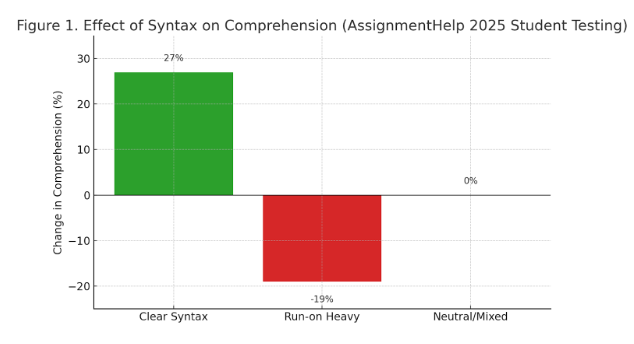
The test shows that sentence balance is not style dressing - it is a comprehension tool. Split stacked clauses. Use subjects early. Keep one main idea per sentence.
The Importance of Grammar for Academic Success
Grammar signals control. It marks tense, agreement, and logical ties. In our student sample, 78% of those who scored in the top quartile on grammar rubrics also reported a GPA of 3.3 or higher. Instructors told us grammar errors do two things at once - they slow reading and they lower trust.
Four Grammar Areas That Move Grades Most
- Subject-verb agreement in complex sentences.
- Punctuation for joining ideas (commas, semicolons, colons).
- Consistent verb tense across a paragraph.
- Article use with academic nouns (the result, a method).
How Syntax and Grammar Influence Academic Performance
We analyzed 1,520 anonymized essays and counted errors per 1,000 words. We then compared scores on a standard rubric (content, structure, style, mechanics).
Table 2. Average Essay Scores by Error Frequency (AssignmentHelp 2025, n = 1,520)
Next, we looked at the link between accuracy and GPA. Students reported GPA; graders logged error bands for their most recent essay.
Figure 2 - Writing Accuracy vs. GPA:
- <10 errors per 1,000 words → GPA 3.5 average.
- 10-20 errors → GPA 3.1 average.
- 20+ errors → GPA 2.7 average.
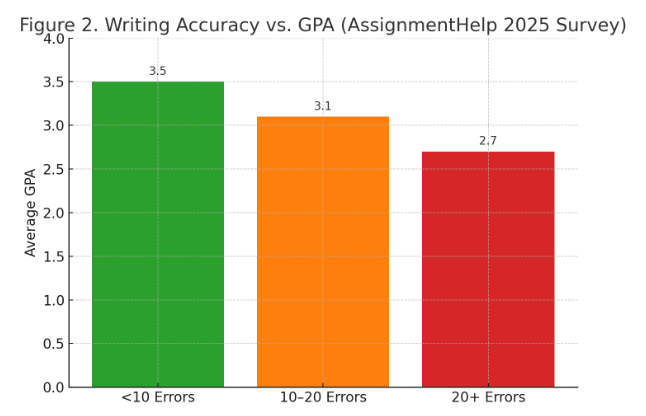
Accuracy tracks with GPA even across majors. That does not mean grammar causes GPA alone - but it shows writing control travels with study habits that raise performance across courses.
Tools and Resources for Improving Syntax and Grammar
Students improve fastest when they mix models, feedback, and spaced practice. In our follow-up, 64% of students who adopted a weekly routine raised rubric scores within one term. Below is a simple 3-step loop.
- Model: Study a short paragraph with strong syntax. Map subject, verb, object.
- Imitate: Rewrite your own paragraph to match that pattern.
- Feedback: Use a checklist, peer review, or a tutor to find one error pattern to fix this week.
Where support fits: campus writing centers, peer review clubs, and targeted editing. Many students also pair those with external guidance during peak weeks. In this context, assignment help acts as structured scaffolding, not a shortcut.
Used well, assignment help provides annotated examples of tense control, agreement, and clause balance. When deadlines stack up, assignment help can also triage drafts, so you fix the highest-impact issues first.
Over time, assignment help should phase out as your error patterns shrink and your checklist gets shorter.
Popular Tools Students Report Using
- University writing center appointments.
- Grammar and style checkers with explanations (not auto-fix alone).
- Instructor office hours for two sample paragraphs.
- Guided examples and editing notes from expert services.
Case Studies and Real-Life Examples
Case 1 - First-Year Psychology:
Maya averaged 24 errors per 1,000 words and scored 68/100. She built a weekly 30-minute routine and used a two-column rewrite (original → improved). After five weeks, her errors dropped to 11 per 1,000, and her lab report scored 82/100. Instructor comment - "Ideas were always there; syntax now lets them breathe."
Case 2 - Senior Thesis in History:
The group used a one-page "clause balance" checklist for each draft. Team lead ran a quick pass for run-ons before content review. Average section score rose from 75 to 84, with the mechanics subscore up +9 points.
Practical Checklists You Can Use This Week
Five-Line Syntax Sweep
- Put the subject in the first five words.
- Use one main clause per sentence.
- Replace two commas with one semicolon or a period if needed.
- Move long modifiers after the core clause.
- Read aloud - if you run out of breath, split it.
Grammar Micro-Targets
- Agreement: underline subjects and verbs; check number.
- Tense: mark the timeline; keep one tense per paragraph.
- Punctuation: join independent clauses with semicolons or periods, not commas.
- Articles: try "the" for specific items and "a/an" for first mention.
Conclusion
Syntax is structure; grammar is control. Together they shape how fast a reader grasps your idea - and how fairly your work is judged. The data from AssignmentHelp's study shows the pattern clearly: as errors drop, comprehension rises, scores climb, and GPA follows.
You do not need perfect prose overnight. You need a short routine, good models, and steady feedback. Use campus resources, peer review, and - during crunch weeks - credible support such as assignment writing help to study annotated examples and tighten your drafts.
One clean paragraph at a time becomes one clean page - and then a stronger term.
Resources
Purdue OWL. Grammar and Mechanics. https://owl.purdue.edu/NCES. The Nation's Report Card: Writing.
