
Sports Culture Philippines: Basketball, Volleyball, and Football
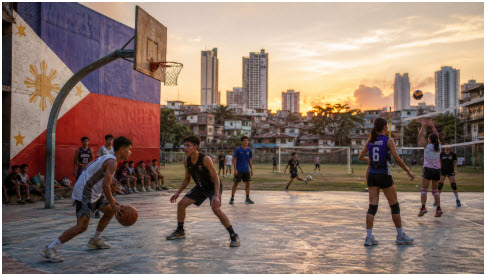
The phrase sports culture Philippines does not start in a national arena. It starts on a painted barangay court at 5 p.m., with a bent rim, a dusty ball, and ten players waiting for one missed shot to decide who stays on. The same country that packs Smart Araneta Coliseum for PBA Finals games also fills school gyms for UAAP volleyball, follows the Filipinas after their 1-0 win over New Zealand at the 2023 FIFA Women’s World Cup, and turns Gilas Pilipinas games into shared viewing appointments. The rhythm is daily: court before dinner, highlights before sleep, group-chat arguments before the next standings update.
The Court That Never Sleeps
The hold of basketball Philippines still comes as much from access as from history. The PBA was founded in 1975 and remains the most visible professional basketball league in the country, but the stronger proof sits in barangay leagues from Quezon City to Cebu, where a 21-point game can pull a crowd before anyone asks who is officiating. Fans who follow the form beyond the local court may place online betting beside PBA scores, NBA props, and Gilas Pilipinas updates, yet the sharper read still comes from the floor: who controls the defensive glass, who avoids the fourth foul, and who can get a clean shot with 8 seconds left. Small details travel upward from the neighborhood game, especially the habit of saving the best defender for the final two possessions. The court stays busy.
Schools Turn Rivalries Into Weekly Memory
School sports give Philippine fandom a roster to argue over before the pros even enter the conversation. Ateneo, La Salle, UP, NU, UST, FEU, San Beda, and Letran turn their student sections into scouting departments, especially when a Final Four game lands at the Mall of Asia Arena or the Smart Araneta Coliseum. A small observation from UAAP basketball: crowds notice when a guard rejects a high ball screen, when a wing shades the right hand, and when a coach hides a weaker defender in the corner after two quick fouls. Those habits explain why a 4 p.m. school game can still dominate dinner talk, even when the PBA has a later tipoff.
Volleyball Found Its Own Noise
The rise of volleyball Philippines has changed the old assumption that only basketball can draw a crowd. PVL and UAAP women’s volleyball built a fan base around players such as Alyssa Valdez, Jia De Guzman, Bella Belen, Angel Canino, and Shevana Laput, and the numbers now back the noise: PVL’s Creamline-Choco Mucho crowd reached 24,459 at the Big Dome in 2024. The sport creates a different kind of tension from basketball because a rally can turn on one reception, one late block touch, or one setter disguising a back set to Zone 2. Fans learned that grammar quickly, which is why a passing breakdown now gets dissected almost as sharply as a missed free throw in a PBA playoff game.
Phones Made the Whole Day a Broadcast
The media changed Philippine sports because fans no longer wait for a newspaper recap or a nightly highlights show. A PVL rally, a Gilas roster update, a PBA import injury, or a Filipinas goal clip can move across Facebook, TikTok, YouTube, X, and Viber before a coach finishes a postgame answer. Some younger fans also track esports betting beside basketball scores, volleyball highlights, and Mobile Legends tournaments, which shows how match viewing and gaming culture now share the same phone screen. That crowded feed does not weaken the old sports; it forces teams and athletes to produce moments clear enough to survive the scroll. The phones stay lit.
Football Has Earned Its Own Room
The growth of football Philippines has become harder to dismiss since the Filipinas raised the sport’s public profile in 2023. Sarina Bolden’s header against New Zealand gave the Philippines its first FIFA Women’s World Cup win, and the Philippine Football Federation later confirmed the Filipinas reached the quarterfinals of the 2026 AFC Women’s Asian Cup before losing to Japan. The men’s team also gave supporters a June 2026 marker with a 5-1 win over Guam at Rizal Memorial Stadium in the Tri-Nation Friendlies. Football still competes with basketball and volleyball for space, but it now has real match footage, real national-team stakes, and real names for younger players to follow.
Betting, Games, and Matchday Habits
Digital entertainment now sits close to sports viewing, especially on weekends, when the NBA, PBA, PVL, football friendlies, and esports events can all fit on one phone. A fan who checks odds, live stats, or online casino games during a long halftime break is part of the same mobile culture that has changed how people watch sports in Manila, Bacolod, Cagayan de Oro, and General Santos. The better habit is still practical: predictions should come from form, injuries, role clarity, and matchup data, not from one noisy highlight or a rushed tap after a timeout. A PBA import’s foul trouble, a PVL team’s weak first ball, or a football fullback pinned deep by a winger tells more than the loudest comment thread. Judgment matters.
The Calendar Belongs to Everyone Now
The old hierarchy has not disappeared, because basketball still owns the most visible everyday footprint. But the Philippines now lives with a wider sports calendar: PBA nights, UAAP weekends, PVL finals, Gilas windows, Filipinas qualifiers, Philippine men’s national team fixtures, and club football from Kaya FC-Iloilo. A student can watch a UAAP volleyball match on Saturday, play half-court basketball on Sunday, and follow a Filipinas update on a phone before class on Monday. That overlap is the real story. Filipino sports life continues to expand because each sport has found its own hour.
