
Portable USB-Powered ONU: Redefining the Future of Fiber Connectivity
Modern network environments are no longer confined to fixed desks, server rooms, or traditional home setups. With the rise of hybrid work models, distributed enterprise networks, and cloud-first applications, connectivity infrastructure is undergoing a quiet but significant transformation.
Traditional Optical Network Units (ONUs), while reliable, were designed for static deployments. They typically require dedicated power adapters, fixed installation points, and structured cabling environments. As network demand becomes more dynamic, these constraints increasingly limit flexibility, especially in scenarios where rapid deployment or temporary connectivity is required.
This is where the concept of the portable USB-powered ONU emerges as a practical evolution. It represents a new category of fiber access device designed to simplify deployment, reduce hardware dependency, and enable truly mobile connectivity while maintaining carrier-grade performance.
What Exactly Is a Portable USB-Powered ONU?
An Optical Network Unit (ONU) is a key endpoint device in fiber-to-the-home (FTTH) or fiber-to-the-x (FTTx) architectures. It acts as the bridge between the optical network and the user’s digital devices, converting optical signals into electrical Ethernet signals.
A portable USB-powered ONU reimagines this concept by integrating power delivery and data transmission into a simplified hardware design that relies on USB interfaces, typically Type-A or Type-C. Instead of relying on bulky external adapters, the device draws power directly from compatible endpoints such as laptops, mini PCs, thin clients, or docking stations.
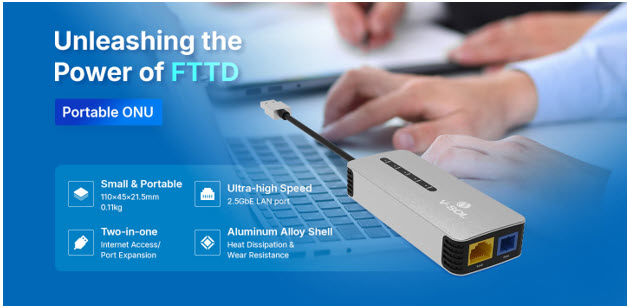
This design significantly reduces setup complexity while preserving core ONU functionality such as:
● EPON/GPON dual-mode access for broader compatibility
● High-speed Ethernet output suitable for modern bandwidth demands
● Stable optical signal conversion for consistent performance
The result is a compact, efficient, and highly portable fiber connectivity solution that aligns with modern IT environments.
How USB Power Transforms ONU Deployment
One of the most impactful innovations in portable ONUs is the integration of USB-based power delivery. While seemingly simple, this shift fundamentally changes how fiber access devices are deployed and managed.
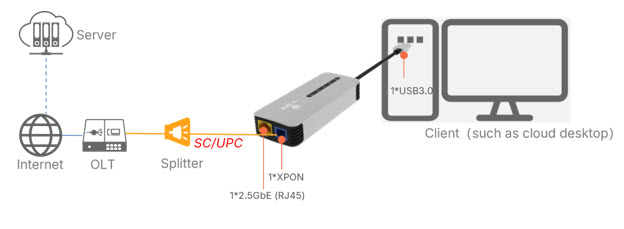
Instead of installing a separate power adapter and ensuring nearby power outlets, users can simply plug the ONU into a USB port. This enables:
● Faster installation with minimal hardware requirements
● Reduced cable clutter in space-constrained environments
● Easier mobility for field engineers and IT personnel
● Greater compatibility with modern computing ecosystems
For example, in a field deployment scenario, a technician can carry a laptop and a portable ONU, connect directly to a fiber drop, and complete provisioning or diagnostics without needing additional equipment. This dramatically improves operational efficiency.
Technical Strengths Behind Portable ONU Devices
When comparing portable ONUs with traditional ONUs, they are engineered for high-performance networking and must meet strict access network standards. Their technical strengths typically include:
● 2.5GbE LAN support, enabling multi-gigabit throughput for bandwidth-intensive applications such as cloud desktops and high-definition streaming
● EPON/GPON compatibility, allowing seamless integration into diverse ISP infrastructures
● Low power consumption architecture, ensuring stable operation within USB power limits
● Compact and thermally optimized design, maintaining performance without overheating
● Plug-and-play usability, reducing the need for complex configuration
Some advanced models also incorporate intelligent firmware features, enabling better interoperability with OLT systems and improving overall network reliability.
Practical Applications Across Industries
Portable USB-powered ONUs are increasingly relevant across multiple industries due to their flexibility and ease of use.
● In enterprise environments, they support temporary office setups, remote workstations, and hot-desking scenarios where employees require immediate access to high-speed fiber networks without permanent installations.
● For ISP technicians and network engineers, portable ONUs serve as efficient tools for fiber testing, service activation, and troubleshooting, reducing the need for bulky testing equipment.
● In industrial environments and IoT deployments, they provide a lightweight way to connect edge devices to fiber backbones, particularly in locations where space and power resources are limited.
Additionally, in cloud computing and virtual desktop infrastructure scenarios, portable ONUs enable direct fiber connectivity to thin clients, supporting high-performance, low-latency access to centralized systems.
Limitations and Practical Considerations
While the advantages are clear, portable USB-powered ONUs also introduce certain constraints that should be considered during deployment.
● USB power availability can vary depending on the host device, which may affect performance stability in edge cases. Ensuring sufficient and stable power output is essential for consistent operation.
● Compatibility with OLT systems is another important factor. Network operators must verify that the ONU firmware aligns with their existing infrastructure to avoid provisioning issues.
● Furthermore, because these devices are often used in mobile or distributed environments, security mechanisms such as authentication, encryption, and remote management capabilities become increasingly important.
Understanding these factors helps ensure optimal performance and reliability in real-world applications.
VSOL and the V2802U: Engineering Practical Portability
Within this emerging category, VSOL has positioned itself as a key innovator in fiber access solutions. The company focuses on developing ONU, OLT, and FTTx ecosystem products that balance performance, reliability, and deployment efficiency.
A representative example is the VSOL V2802U portable ONU, which reflects the direction of next-generation fiber access devices.
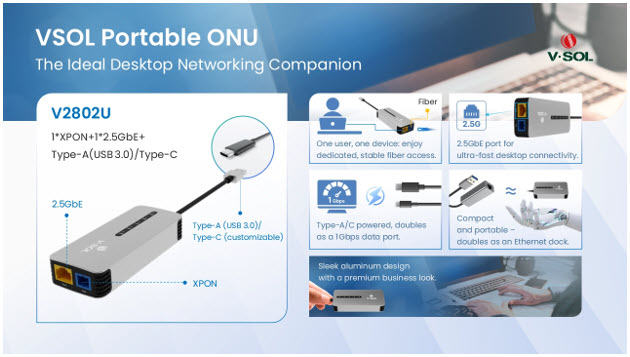
The V2802U integrates:
● USB-powered operation via both Type-A and Type-C interfaces
● 2.5GbE high-speed Ethernet output for modern bandwidth needs
● Dual-mode EPON/GPON compatibility for flexible deployment
● Ultra-compact design suitable for desktop and mobile scenarios
This combination enables a streamlined deployment experience, particularly in FTTD (Fiber to the Desk) environments where simplicity and speed are essential.
By removing the need for external power supplies and reducing physical complexity, the V2802U provides a practical solution for both operators and enterprise users seeking efficient fiber access.
The Future of Portable Fiber Connectivity
The rise of USB-powered ONUs reflects a broader transformation in network infrastructure design. As organizations adopt cloud-based workflows and distributed architectures, the demand for flexible, user-centric connectivity solutions continues to grow.
Future developments are likely to include:
● Wider adoption of desk-level fiber access points
● Integration with edge computing and AI-driven network management
● Enhanced power efficiency and performance optimization
● Greater standardization across USB-powered networking devices
These trends suggest that portable ONUs will play an increasingly important role in bridging high-speed fiber networks with modern computing environments.
Conclusion
The portable USB-powered ONU represents a meaningful evolution in fiber connectivity. By combining optical access technology with USB-powered portability, it removes many of the limitations associated with traditional ONU deployments.
Solutions such as the VSOL V2802U demonstrate how compact design, efficient power usage, and high-speed performance can coexist in a single device.
As network environments continue to evolve toward flexibility and decentralization, portable ONUs are poised to become a key component in next-generation FTTx deployments, enabling faster, simpler, and more adaptable fiber access across a wide range of applications.
