
PayID Pokies Australia vs Traditional Casino Payment Methods
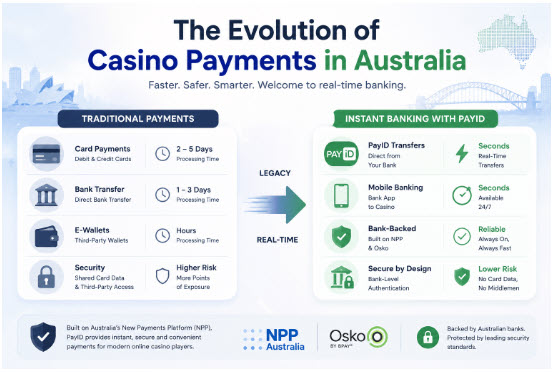
Instant payment infrastructure has reshaped how Australians fund and withdraw from online casino accounts. PayID pokies Australia platforms have grown as the New Payments Platform (NPP) expanded throughout Australian banking networks, bringing near-real-time transfers within existing bank accounts without additional registration.
The Shift Towards Instant Banking: The popularity of online PayID pokies illustrates how Australian payment habits have changed with the rise of real-time bank transfers, giving users greater control over transaction speed and convenience.
Aussies request faster deposits and withdrawals, which a PayID casino Australia can guarantee. Australia’s PayID system reduces wait times, offering cleaner payment flows compared with card-based or e-wallet alternatives. Everyone who chooses online pokies Australia PayID has access to faster payment rails within an established banking ecosystem. Bank-level authentication, payment settlement within seconds and reliable, state-level infrastructure displace dubious intermediaries and remove processing delays from user interactions with Australia-facing casinos. Our review provides a comprehensive picture of how PayID-friendly operators differ from platforms offering traditional payment options in terms of speed, security, fees, and usability.
Why PayID Pokies Australia Have Become the Preferred Choice for Online Casino Players
The method’s support gains momentum as Australia-facing casinos realise Aussies prioritise PayID. The top reasons for choosing it over other payment methods are discussed below to justify its quicker adoption among international iGaming platforms targeting Australian user bases.
Instant PayID Deposits and Fast Withdrawal Online Casino Australia Options
The NPP processes PayID transactions, guaranteeing instant PayID withdrawal casino games in Australia. It works 24/7, including public holidays, to ensure near-real-time transaction completion. Such a structural advantage over card processors and bank transfers, which operate on business-day clearing cycles, delivers fast payouts for online pokies Australia that players appreciate. Deposits appear in user accounts within seconds, which is more predictable than other payment methods that are affected by peak-traffic lags or batch-processing delays.
Withdrawal speed is where instant PayID pokies Australia real money gain a genuine market advantage. Forward-looking platforms have integrated Osko into withdrawal pipelines, minimising wait times to 15–30 minutes rather than days of bank settlement. As withdrawals are stretched by internal approval timeframes and receiving-bank settlement procedures, PayID optimises both.
Secure PayID Casino Australia Transactions Through Australian Banking Networks
Every secure PayID casino Australia routes transactions into the NPP authentication layer, meaning the bank’s existing multi-factor authentication and fraud detection systems apply to every transfer. Modern PayID security standards support a payment environment focused on identity verification, secure transaction processing, and reduced reliance on sensitive card information. Players using PayID casino Australia real money withdrawals don’t share card numbers, CVV codes, or expiry dates, harnessing bank-level security and FinTech speed optimisation. Such an architecture reduces casino compliance exposure by removing third-party dependency and security risks associated with card data storage.
Easy Setup and Mobile-Friendly PayID Online Casino Australia Payments
Setting up an account is easy for any Australian bank user. A mobile number, email address, or ABN must be provided via a bank’s app or internet portal to receive a unique address. Aussies playing online pokies Australia with PayID benefit from fast, confidential money transfers without unnecessary risk exposure. Users enter unique identifiers without creating separate wallets or using third-party processors, handling money movements in several clicks.
PayID online casino Australia payments on mobile devices process quickly, with deposit initiation and confirmation occurring directly between casinos and banking apps, without intermediary payment gateways. Players managing sessions on smartphones have lower friction at the deposit step without compromising safety.
Lower Fees and Better Convenience Compared with Traditional Methods
Personal PayID transfers carry no transaction fees for senders under standard NPP terms. By contrast, card-based casino deposits incur a 1–3% surcharge charged by card schemes or casino payment processors. E-wallet withdrawals on many platforms apply percentage-based fees that accumulate during multiple transactions. The fee differential compounds for players who engage in regular deposit and withdrawal activity, reducing net returns that PayID transactions don’t affect.
What Is PayID and How Does It Work in Australian Online Casinos?
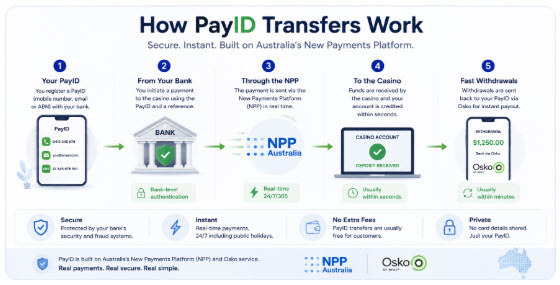
The PayID payment method Australia uses is an addressing system built on the state’s New Payments Platform, launched in 2018 and operated by NPP Australia Limited. The underlying NPP infrastructure enables real-time payment capabilities across participating Australian financial institutions. It allows bank account holders to register a simple identifier (a mobile number, email address, or Australian Business Number) with their accounts to simplify transactions. Transfers still move between bank accounts via NPP’s real-time settlement infrastructure, but PayID makes the process human-friendlier.
Players targeting PayID deposit casino Australia use casinos’ identifiers and reference numbers. They initiate transfers from their banking apps to the casino ID, including a reference that the finance department can use to match incoming funds to a specific user profile. Account balances are typically credited within seconds. Withdrawals involve sending funds to the user’s ID via Osko, the NPP’s overlay service for real-time payments.
PayID’s popularity among Aussies reflects its alignment with the core values of mobile banking: security, speed, and simplicity. NPP Australia reported over 16 million registrations by 2024, with rising transaction volumes every year. Its adoption among Australia-facing casinos is associated with growth in the user base, giving licensed platforms a new lever for attracting new players.
PayID vs Traditional Casino Payment Methods – Complete Comparison
Traditional payment methods and PayID allow players to fund and withdraw funds from their accounts. They differ in terms of transaction speed, convenience, security, fees, and user experience. PayID utilises the Australian banking infrastructure to settle payments in real time. Traditional methods rely on legacy systems, which are blamed for processing delays or additional costs. Find a structured comparison in the table below.
Is PayID Safer than Traditional Casino Payment Methods?
Security assessment of PayID versus traditional payment methods involves examining specific risk categories. The PayID payment method Australia possesses a structural security advantage. Transfers go through the Australian banking system similar to traditional bank transactions, with identical safety safeguards applied at every step. Multi-factor authentication, fraud monitoring, and dispute resolution mechanisms operate at the bank level, without requiring casinos to handle sensitive financial data.
Card payments have a different risk profile. The card number, expiry date, and CVV are transmitted through the casino’s payment processor, obliging casinos to ensure the secure and compliant storage and handling of sensitive financial data. PCI DSS-compliant processors store data in third-party environments, creating an additional point where sensitive information must be protected. A secure PayID casino Australia, in turn, never includes player credentials in the payment chain, with all data anonymised and limited to the PayID identifier.
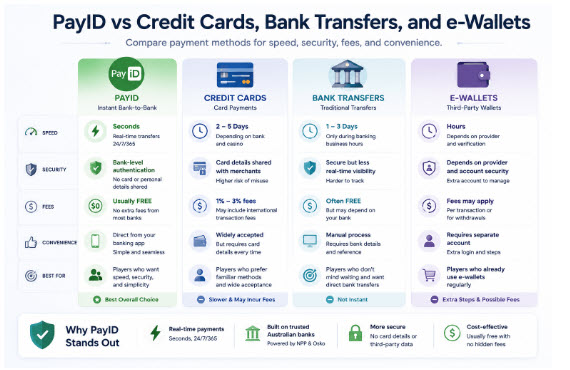
PayID vs Credit Cards, Bank Transfers, and e-Wallets
Casinos employ distinct privacy handling measures. PayID transactions don’t require financial data retention or its downstream sharing. PayID's name-matching process mitigates misdirected transfers, helping protect players from sending funds to the wrong recipient. For players concerned about financial privacy, PayID offers a confidential way to channel casino deposits and withdrawals without exposing sensitive data.
PayID vs Credit and Debit Cards
Credit and debit card deposits go through the Visa and Mastercard networks, which have lengthy settlement cycles and rules that do not apply to PayID. Card deposits credit within minutes, but batch-processing delays during peak periods can extend deposit timelines. Withdrawals to cards take longer, while reversal processing takes 2–5 business days and can’t be accelerated by users or operators. Card transaction fees are 1–3%, with transaction costs compounding during regular activity. Such features are not present in PayID, which involves no card, and the banking app’s existing authentication flow ensures immediate settlement.
PayID vs Traditional Bank Transfers
Direct bank transfers using BSB and account numbers are popular among Aussies, but they impose the longest processing times. Standard bank transfers settle 1–3 business days, while withdrawals take up to one week. The NPP was launched to address latency by using bank infrastructure for fast-track money movement. Account verification requirements for bank transfers pose greater privacy risks, whereas a PayID identifier simplifies transactions without requiring BSB and account numbers.
PayID vs e-Wallets Such as PayPal, Skrill, and Neteller
E-wallet transactions are quick, but e-wallets serve as an intermediary layer in player-casino interactions. Users must transfer funds from bank accounts to e-wallets, complete identity verification, fund their e-wallets, and then transfer funds to casino balances. Withdrawal fees are another barrier to effective usage. Most wallets, such as Skrill and Neteller, charge percentage-based or fixed fees for casino withdrawals. PayPal’s fee structure depends on transaction and account type, but fees are always present.
Should Australian Players Switch to PayID Pokies in 2026?
PayID delivers multiple benefits to players conducting regular casino deposits and withdrawals. It suits everyone who prioritises speed, low fees, and minimal data exposure. Providers of new PayID pokies Australia respond to changing preferences by adding PayID to their lists of supported payment methods. With new insights in mind, one can characterise the best PayID casino in Australia as a platform with native PayID support for deposits, an integrated Osko withdrawal pipeline, and no specific restrictions such as low withdrawal limits or slow internal clearing protocols.
