
How to Spot Tilt in Three Hands and Stop Before It Costs You
Nobody decides to play badly. Tilt arrives quietly, after a bad beat or a run of small losses, and by the time a player notices it, several expensive hands are already behind them. Whether you play live or online at a site like BC Poker, the warning signs show up early, often within three hands of the first emotional jolt. Here is how to spot them and leave the table in time.
What Tilt Really Is
Tilt is a state in which emotion starts making decisions that strategy should make. Anger is the usual cause, but frustration, boredom, and overconfidence after a big win can have the same effect. The cost is rarely one catastrophic hand; more often it is a slow leak of extra calls, oversized bluffs, and loose hands.
Common Triggers
● A bad beat when you were far ahead
● Your own mistake
● An opponent who needles or stalls
● Fatigue or outside stress

The Three-Hand Check
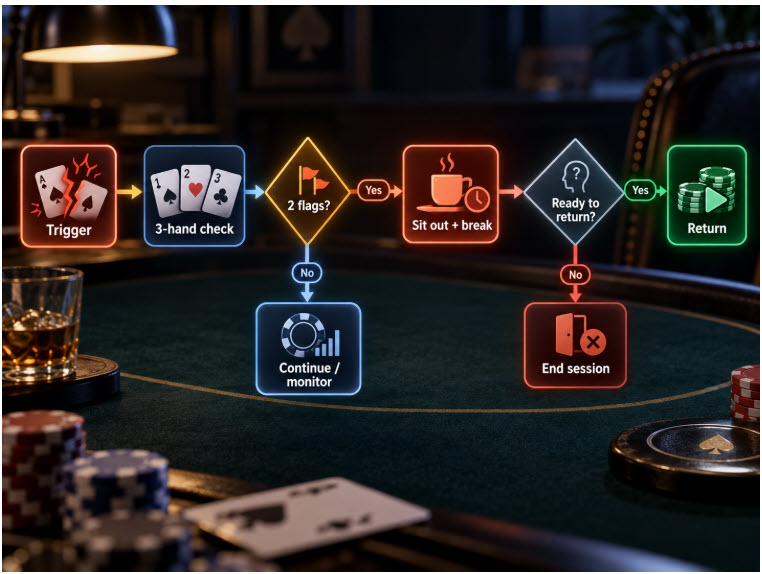
After any trigger, watch the next three hands. Each one tests a different layer.
|
Hand |
What to watch |
What it can look like |
|
First |
Body and mood |
Tight jaw, faster breathing, the urge to “get it back” |
|
Second |
Strategy drift |
A call you would usually fold, a bigger bet than planned |
|
Third |
Justification |
Excusing the play: “they bluff too much, so I must call” |
One flag means slow down. Two flags signal that tilt has started. Three mean it is time to stop.
Four Quick Self-Test Questions
- Would I play this hand the same way in the first hour?
- Am I acting faster than usual?
- Am I thinking more about lost money than the hand in front of me?
- Could I explain this line calmly to a coach?
If any answer is uncomfortable, you need a pause.
Build an Exit Protocol Before You Need It
Decisions made in advance are easier to follow than those made mid-session, when your judgment is already compromised.
● Set limits. Choose a maximum duration and a stop-loss. If you play on mobile, such as in the BC Poker app, use any built-in loss limits.
● Define trigger rules. For example: “Two flags in one orbit means a break.”
● Follow a fixed exit sequence. Sit out, close extra tables, stand up, and leave the screen.
● Make a re-entry rule. Return only if you can answer the four questions calmly.
Never add money to chase your losses. Topping up turns a mental problem into a financial one.
The Break and the Review
A break only works if it changes your state, so walk outside, drink water, and breathe slowly. Later, label the hands played after the trigger in your hand history as mental game errors, separate from strategic ones, and adjust your session length, stakes, or schedule accordingly.
When It Is More Than Tilt
If you regularly play longer than planned, chase losses, or notice gambling affecting your mood, relationships, or finances, that is a different problem. Talk with someone you trust and consider GamCare or Gambling Therapy. Poker is for adults aged 18 and over, and tools like deposit limits and self-exclusion exist for a reason, so check what your room offers, for instance at https://bcplaypoker.com/.
Leaving the Table on Your Own Terms
Tilt is a predictable response, and the players who handle it best are the ones who prepared. Learn your triggers, run the three-hand check, and keep an exit plan that does not depend on how you feel. The hand you fold by walking away is often the day’s most profitable one.
