
How Much Do Voice Actors Get Paid for Video Games?
People usually search for voice actors to pay for video games for one reason: to set a budget. And it’s not just for main characters - games need lots of NPC lines, battle shouts, and last-minute pickups when the script changes.
The key thing to know is simple: most game voice work is paid by session, so the final cost depends on how many sessions you need and how much re-recording happens.
How much do voice actors get paid for video games?
There isn’t one fixed number. Game VO is usually paid by sessions, and the rate depends on:
● Union vs non-union
● How many sessions you need
● How vocally intense the work is
● How much rework/pickups you expect
● Rights and AI-related approvals
If you understand those five levers, you can budget accurately in minutes.
1. The two common pay models (most producers use one of these)
Model A - “Session / hour rate” (typical non-union)
A common indie baseline is $250 per hour with a 2-hour minimum (so the base session is $500).
You then pay $250 for each additional hour in that session.
Why this model exists: direction and retakes eat time. Paying “per line” usually backfires.
Model B - “Union day/session minimums” (SAG-AFTRA)
Union game VO commonly follows minimums under the Interactive Media Agreement. For example, a widely listed category is Day Performer (up to 3 voices / 4-hour day) - with a published minimum like $1,102 on the wage table (and later rate sheets showing higher numbers after scheduled increases).
Why union is structured this way: it sets a floor and adds protections/requirements around the work.
2. What you’ll actually pay in practice (simple ranges)
Use these as planning ranges, not quotes:
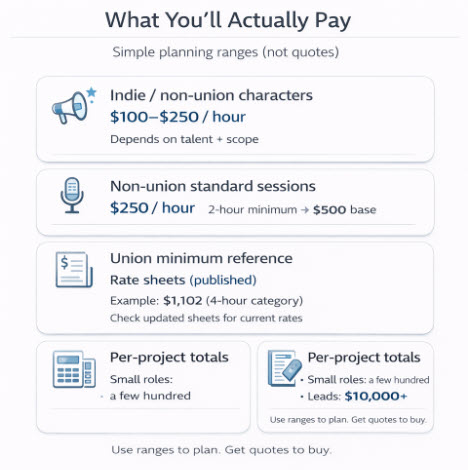
● Indie / non-union characters: often $100–$250/hour depending on talent and project.
● Non-union “standard” session structure: $250/hour, 2-hour minimum (base $500).
● Union minimum reference point: day/session minimums around the published rate sheets (example: $1,102 for the 4-hour category, with later increases reflected on updated sheets).
● Per-project totals: small roles can be a few hundred dollars; leads can go $10,000+ depending on sessions and scope.
3. The 5 things that change the cost the most (this is the budget logic)
1) Number of sessions (the real cost driver)
Games change. You will have:
● script rewrites
● UI changes
● bug fixes that require new lines
● live-ops seasonal content
Each wave creates pickups. Pickups = more sessions.
2) Role type (lead vs supporting vs NPC)
● Leads cost more because they require more sessions + performance direction.
● NPC packs can be efficient if you record multiple voices per session.
3) Vocally stressful work
Combat barks, screams, heavy effort sounds usually require stricter handling and can add cost/complexity (and more breaks/limits).
4) Studio overhead (even if the actor is remote)
You may pay for:
● engineer
● session direction
● editing/splitting files
● naming conventions and delivery specs
This often becomes a hidden second budget.
5) Rights + AI-related approvals
Industry contracts and expectations increasingly emphasize consent/disclosure/controls for AI replicas and reuse. That impacts negotiations and workflows - sometimes more than the raw recording rate.
4. A budgeting formula you can actually use
Step 1 - Estimate sessions
Start with rough session counts:
● Small indie (some voiced scenes + NPCs): 2–8 sessions total
● Mid-size narrative game: 10–30 sessions
● AAA / heavily voiced + live-ops: 30+ sessions across production
(You’ll refine once you know word count and how many pickup cycles you expect.)
Step 2 - Apply a rate model
● Non-union baseline: $500 base per session (2 hours), then +$250/hour.
● Union: use the current rate sheet categories as your floor.
Step 3 - Add “rework tax”
Add a buffer for pickups:
● +15–25% if your script is stable
● +30–60% if you have live-ops or late narrative changes
This buffer is what keeps budgets from exploding later.
5. Three quick examples (no math gymnastics)
Example A - NPC pack (non-union)
You need 6 hours total across a few voices.
At $250/hour with 2-hour minimum sessions, that’s typically 3 sessions → about $1,500 actor fees (plus engineering/editing).
Example B - One supporting character (union-style structure)
Character needs 3–4 sessions across production + pickups.
Budget = (union session/day minimum) × (sessions) + studio/editing.
Example C - Lead character
Lead role might run many sessions across months; totals can reach $10,000+ depending on scope.
6. Where Respeecher makes it easier (the simple truth)
The biggest VO cost in games is rarely “day one recording.”
It’s re-recording because schedules change.
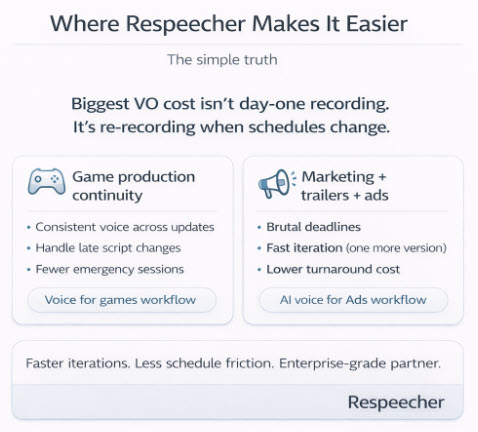
Respeecher helps teams reduce that pain in two common places:
- Game production continuity
When you need consistent voice output across updates, expansions, or late script changes, a workflow built for voice for games can reduce dependence on repeatedly booking the same talent for every small change.
- Marketing + trailers + ads
Promo content has brutal deadlines and constant iteration. Using an AI voice for Ads workflow can cut turnaround time and lower the cost of “one more version by tomorrow.”
If you’re trying to control budget, the practical pitch is simple: fewer emergency sessions, faster iterations, less schedule friction - with an enterprise-grade partner like Respeecher.
The clean takeaway
Voice actor pay for video games is usually session-based:
● Non-union indie baseline often referenced: $250/hour with a 2-hour minimum.
● Union work uses published minimums on current rate sheets (example category values are listed by SAG-AFTRA and updated as increases apply).
Your final budget is driven by sessions + pickups + studio/editing + approvals (not by line count).
