
How AI-Generated Text Is Detected: Signals, Limits, and Context
AI-generated writing no longer announces itself with obviously robotic sentences.
Modern language models can produce emails, essays, blog posts, summaries, product descriptions, and social posts that read smoothly enough to pass as human writing at first glance. That has created a new category of internet vocabulary around machine-written language: “AI slop,” “GPT-ese,” “burstiness,” “perplexity,” and, increasingly, the AI detector.
But detecting machine-generated text is more complicated than spotting a few suspicious words.
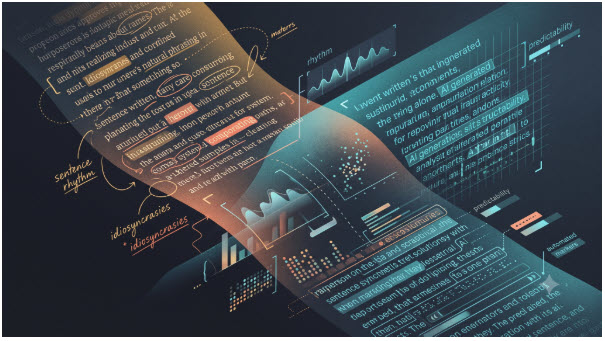
AI detection tools do not usually search for a hidden label that says a passage came from a language model. Instead, they analyze statistical and linguistic patterns that may be more common in generated text than in human writing.
Those patterns can be useful signals.
They are not proof.
Understanding that difference is essential for anyone using detection tools in education, publishing, hiring, marketing, or everyday online communication.
AI writing has patterns, but no single fingerprint
People often imagine AI-generated text as having a recognizable style.
There is some truth to that.
Generated writing can sometimes rely heavily on predictable transitions, balanced sentence structures, generic conclusions, repetitive phrasing, or vocabulary that feels polished without being particularly specific.
Certain phrases become fashionable across large numbers of generated responses. Once enough people notice them, they turn into internet shorthand for “this sounds like AI.”
But language models do not have one permanent writing voice.
Their output changes based on:
● the model being used;
● the prompt;
● the requested tone;
● the subject;
● the amount of context provided;
● subsequent human editing.
A short factual answer generated from a simple prompt may look very different from a long article produced with detailed instructions and then revised by a human editor.
This is why detection systems usually rely on broader patterns rather than individual words.
What does “perplexity” mean?
One term that frequently appears in conversations about AI detection is perplexity.
In language modeling, perplexity is related to how predictable a sequence of words is to a model. Lower unpredictability can sometimes be associated with generated text because language models are designed to choose plausible continuations based on patterns learned during training.
Human writing can be less predictable.
People change direction. They use unusual expressions. They interrupt their own rhythm. They choose words because of personal experience, humor, emotion, or context that a statistical model may not naturally reproduce.
That does not mean predictable writing is automatically AI-generated.
A technical manual, formal report, standardized business email, or essay written by someone using simple English may also contain highly predictable language.
That distinction becomes important later.
What is burstiness?
Another term often mentioned in AI-detection discussions is burstiness.
Informally, burstiness refers to variation in writing patterns.
Human writers frequently alternate between short and long sentences. They may write a compact statement, follow it with a detailed explanation, then return to something brief.
Generated text can sometimes be more uniform.
For example:
The platform improves productivity by automating repetitive workflows. It also helps teams organize tasks more effectively. In addition, users can track progress through centralized dashboards.
There is nothing grammatically wrong with the passage.
The sentences simply have a similar rhythm and structure.
A human editor might naturally create more variation:
Automation removes much of the repetitive work. Teams can then spend more time solving problems instead of updating spreadsheets or chasing status reports. Progress still needs to be tracked, of course, but a centralized dashboard can make that far easier.
Again, neither example proves who wrote the text.
Burstiness is a pattern, not a signature.
Why detectors look at several signals together
Because no individual feature is reliable enough on its own, detection systems typically consider multiple signals.
These may include statistical predictability, sentence variation, word choice, token patterns, repetition, and relationships between different parts of a passage.
NIST’s Generative AI evaluation program is actively testing both AI generators and discriminators to understand how effectively machine-generated text can be distinguished from human writing. Its evaluations show that performance varies substantially across generators and detectors: some generated text can fool many detection systems, while some detectors perform much better against particular generators.
That is an important reminder that “AI detection accuracy” is not one fixed number.
Performance depends on what text is being tested, which model produced it, how the detector was trained, and whether the text was edited afterward.
Where an AI detector fits into the review process
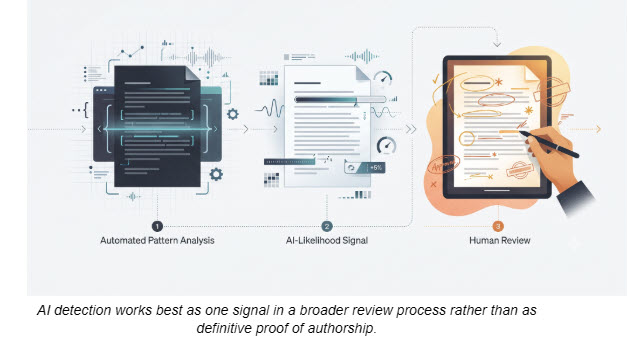
Detection becomes most useful when it is treated as a screening signal rather than a final verdict.
An AI Detector can analyze a passage for patterns associated with machine-generated writing and provide an additional piece of information for someone reviewing the text.
That can be useful when an editor is assessing a large volume of content, an educator is reviewing an unusual submission, or a writer simply wants another perspective on how a draft reads.
The result should prompt questions rather than automatically answer them.
If a passage receives a strong AI likelihood score, a reviewer might look more closely at the writing process, compare it with previous work, check sources, or ask the author about how the material was created.
The detector provides context.
The human reviewer interprets it.
False positives are a real problem
One of the biggest reasons detection scores should be interpreted carefully is the possibility of false positives.
A false positive occurs when human-written text is incorrectly classified as AI-generated.
Research from Stanford found a particularly important example of this problem. In a study of seven GPT detectors, more than half of the examined TOEFL essays written by non-native English speakers were incorrectly classified as AI-generated.
The likely reason is closely connected to the statistical patterns detectors measure.
People writing in a second language may use more predictable vocabulary and sentence structures. A detector may interpret those patterns as evidence of machine generation even when the work is entirely human.
This creates an obvious fairness concern.
A tool designed to identify machine-written text should not become a shortcut for judging writing style, language proficiency, or authorship.
Human editing makes detection harder
Another complication is that modern writing workflows are rarely completely human or completely automated.
Someone might use AI to brainstorm an outline, then write the article independently.
Another person might draft a paragraph themselves and use AI to improve grammar.
A third might generate an initial draft and rewrite nearly every sentence.
Which one counts as “AI-written”?
There is no universal technical answer because the writing exists on a spectrum.
NIST notes that AI-generated and human-generated text can be mixed easily, and that paraphrasing or editing can make detection substantially more difficult. NIST
This is one reason document-level percentages should be interpreted cautiously.
A score may indicate statistical characteristics of the final text without revealing exactly how the document was produced.
Detection is different from plagiarism checking
AI detection and plagiarism detection are often discussed together, but they solve different problems.
Traditional plagiarism systems generally compare submitted writing against existing sources to identify matching or closely related text.
AI detectors usually do something different.
They estimate whether the writing displays characteristics associated with machine-generated language.
That means a passage can be:
● completely original but AI-generated;
● human-written but plagiarized;
● AI-assisted and properly cited;
● human-written and falsely flagged by an AI detector.
Combining these concepts into one score can create confusion.
Authorship, originality, citation, and responsible AI use are related questions, but they are not interchangeable.
Context matters more in high-stakes decisions
The higher the stakes, the more careful interpretation needs to become.
A casual blogger checking a draft has little to lose from an incorrect result.
A student accused of academic misconduct has much more at stake.
UNESCO’s guidance on generative AI in education calls for a human-centered approach to AI governance and responsible use rather than treating automated systems as substitutes for educational judgment.
In practice, that means a detection result should be combined with other evidence.
For educators, that might include drafts, revision history, citations, previous writing samples, assignment discussions, or a conversation with the student.
For publishers, it might involve source checking, factual verification, editorial review, and understanding the author’s workflow.
Technology can help identify what deserves closer attention.
It should not eliminate the need to investigate.
Can humans reliably spot AI writing?
People often believe they can identify AI writing instantly.
Occasionally they can.
Generic phrasing, suspiciously balanced paragraphs, repetitive transitions, fabricated details, or an oddly impersonal tone may raise legitimate questions.
But humans also develop unreliable shortcuts.
A writer who uses formal language may be accused of sounding artificial. Someone with an unusually structured style may trigger suspicion. Meanwhile, sophisticated generated text may appear completely ordinary.
The challenge becomes harder as language models improve.
NIST’s current text evaluations explicitly examine how convincingly generators can imitate human-authored writing and how effectively discriminators can tell them apart.
The boundary is therefore moving.
Detection practices have to move with it.
The best question is not always “Who wrote this?”
AI has complicated the idea of authorship.
A better question in many contexts may be:
How was this created, and was that process appropriate for the situation?
A journalist using AI to fabricate quotations is very different from one using it to summarize interview notes before independently checking the result.
A student submitting a generated essay as original work is different from a student using an approved AI tool to brainstorm research questions.
A marketing team using AI to create a first draft is different from publishing generated claims without fact-checking them.
Detection tools can contribute to these conversations.
They cannot resolve them alone.
AI detection is a signal, not a verdict
The internet is becoming a mixture of human writing, generated writing, and everything in between.
That makes understanding AI detection increasingly useful.
Statistical features such as predictability, sentence variation, and linguistic patterns can provide clues about how text may have been produced. Modern detectors combine many of these signals to estimate whether a passage resembles machine-generated writing.
But estimation is not certainty.
False positives exist. Editing changes detection outcomes. Different models produce different patterns, and human writing varies enormously across language backgrounds, subjects, and styles.
The most sensible approach is therefore neither to dismiss AI detection entirely nor to treat every score as definitive.
Use detection to identify what deserves a closer look.
Then use context, evidence, and human judgment to decide what the result actually means.
