
Gambling Glossary: A–Z of Common Casino & Gambling Terms
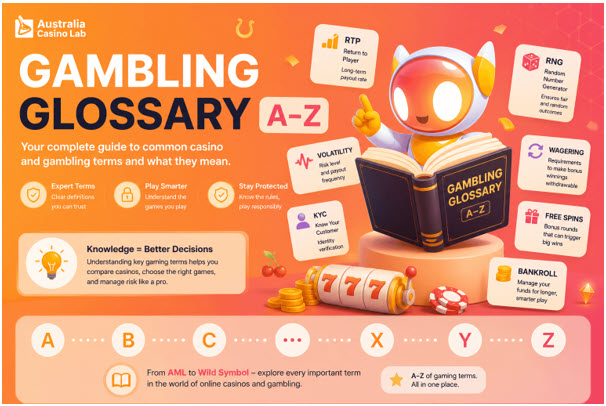
In 2026, gaming terminology operates as a financial control layer in Australia's highly regulated gambling markets. Data from professional platforms show average RTP values between 94.5% and 97.2%, reflecting a market that demands high transparency. Video game terms like variance and hit frequency shift payout cycles from 20 to 500 spins, depending on the specific software configuration.
Expert Commentary: A systematic review of the best online casinos Australia demonstrates that top-tier operators now utilize a standardized game glossary to ensure players can verify RTP metrics and software provider credentials before committing their bankroll to long-term sessions.
Misreading a single gaming word, such as volatility or wagering requirements, directly affects the speed at which the bankroll is depleted and can significantly alter withdrawal eligibility. In Australian online environments, compliance frameworks link every transaction to defined video game terminology, including KYC checks completed within minutes and AML monitoring for deposits above the AU$1,000 threshold. Online gaming words no longer function as simple descriptive labels; each term maps to a measurable parameter inside the game engine or bonus logic.
The A–Z Dictionary: Essential Gaming Terms and Meanings
Our video game terminology list focuses on measurable impact, not just superficial labels. Each term links to balance movement, withdrawal timing, or payout probability. Gaming terms and meanings define the cost structure, risk spread, and system control within modern engines.
● A – AML (Anti-Money Laundering): AML monitors transaction patterns through automated thresholds. In Australia, transactions between AU$2,000 and AU$5,000 usually trigger manual checks or behaviour flags.
● B – Bankroll, Bonus Buy, & Bet Level: Bankroll sets the total session capacity. Bet level defines exposure per spin cycle. Bonus buy converts balance into direct access to features, increasing short-term risk concentration.
● C – Cashback & Cashable Bonus: Cashback offsets net losses over fixed periods. The cashable bonus converts to a withdrawable balance upon completion of wagering (turnover requirements range between 20x and 40x).
● D – Demo Mode & ACMA Compliance: Demo mode mirrors live RTP and volatility settings without financial exposure. ACMA (Australian Communications and Media Authority) guidelines ensure payout logic is consistent and audited, with regulatory information published through the official ACMA framework.
● F – Free Spins & Feature Trigger: Free spins activate bonus cycles without reducing the balance. Gamer lingo defines a feature trigger as unlocking high-multiplier states, appearing every 80 to 200 spins.
● G – Game Provider (Slot Provider): Providers control engine logic and RTP configuration. Identical titles may run at different RTP levels depending on the AU deployment.
● H – House Edge & Hit Frequency: House edge is the percentage retained from total wagers. Hit frequency controls the payout rhythm, staying around 15% in high variance games.
● I – Instant Play (No Download): Instant play runs through browser-based engines. In computer gaming terms, load latency should range between 2 and 5 seconds for optimal stability.
● K – KYC (Know Your Customer): A vital part of video game vocabulary, KYC validates identity before withdrawals, typically taking 24–72 hours in the AU market.
● L – LGO (Licensed Gambling Operator): LGO status confirms regulatory approval and operational compliance with Australian standards and auditing cycles.
● M – Max Win & Max Cashout: Max win caps the payout per round. Max cashout limits withdrawal from bonus-derived balances, often capped at 3x to 10x the bonus value.
● P – Pokies (AU Local Term): Pokies refer to slot machines in Australian gamer slang. This applies to both digital and land-based formats with RTPs from 90% to 96%.
● R – RGS (Remote Gaming Server) & RNG: RGS manages execution. RNG (Random Number Generator) generates outcomes at millisecond speed, with fairness testing and certification standards commonly associated with organisations such as eCOGRA.
● S – Sticky Bonus & Scatter Symbol: Sticky bonus locks bonus funds until wagering completes. Scatter symbols trigger features independently of paylines.
● V – Variance (Volatility): Quantifies payout distribution. High variance produces rare, large wins (the "Epic Loot" style), while low variance maintains frequent small payouts.
● W – Wagering Requirements & Wild Symbol: Specifies the turnover volume required before withdrawal. Wild symbols substitute standard symbols to increase the hit rate.
Mechanics: Video Game Jargon and Payout Terms of Games
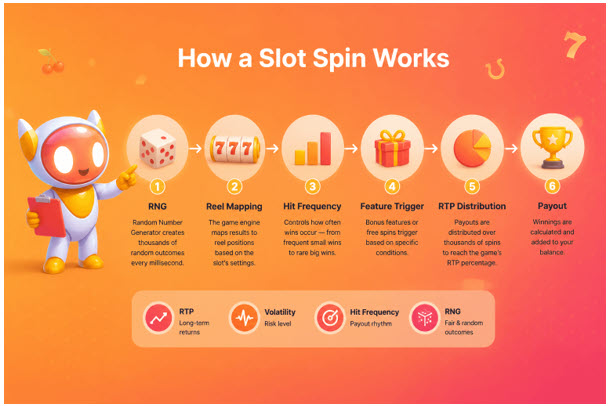
Each spin completes a full calculation cycle within 20 to 80 ms, combining RNG output, reel mapping, and payout validation. Video game jargon, including terms like “tick rate” and “loop cycle”, implies spin frequency and outcome refresh speed. Bonus trigger probability follows fixed ranges. Standard configurations activate features once every 80 to 200 spins. High-volatility setups extend beyond 250 spins. Combined with hit frequency, it defines total event density per session. A 1,000-spin cycle may include 5 to 12 feature activations depending on reel weighting. Lower-density systems reduce trigger frequency but increase payout size per event. An internal structure defines outcome distribution more than visual presentation. RTP operates during extended cycles, not short sessions. A 96% RTP game pays back about AU$96 for every AU$100 over long sessions. Short cycles show deviation. In a 100-spin sample, returns may drop to 70% or exceed 120% due to variance clustering. Hit frequency defines win intervals of 3–10 or 20–50 spins, depending on the configuration.
● High-volatility slots: 15% to 20% hit rate (1 win every 5–7 spins), reflecting “Boss Fights” in video game lingo.
● Medium volatility: 25% to 35% hit rate (1 win every 3–4 spins).
● Low volatility: Over 40% hit rate, resulting in frequent small returns, aligning with the gamer word “Grinding”. Wins appear every 5 to 12 spins (0.5x to 2x bet size).
Professional Selection Matrix for Gaming Language Words
|
Gaming Language Words |
Practical Definition |
Strategic Gamer Slang Application |
|
Sustainability (RTP) |
Bankroll endurance during 500–1,000 spins at 94% to 97% return range. |
Staying longer to hit a feature cycle. |
|
Variance (Volatility) |
Risk spread between frequent 1x wins or rare 500x payouts. |
Choosing a "Steady Farm" vs "Epic Loot" style. |
|
Integrity (RGS/Audit) |
Certified RNG output tested under regulatory AU intervals. |
Checking if the game is non-rigged. |
Bonus Strategy: Gaming Slang Terms and Gamer Lingo
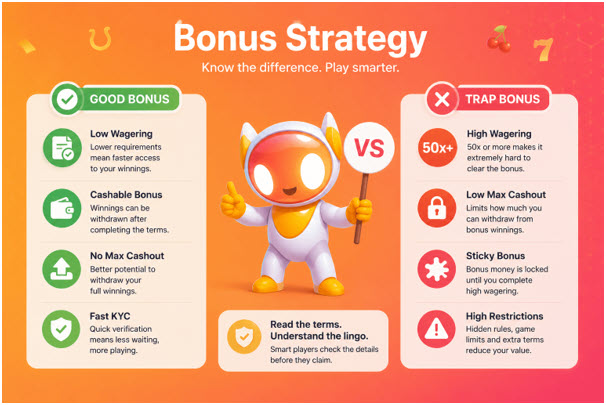
Bonus structures operate as controlled-value systems. A standard 40x wagering condition converts a AU$50 bonus into AU$2,000 turnover. Game jargon identifies the balance as “Locked”. Gaming slang terms classify bonus types based on withdrawal behaviour. Sticky bonuses are excluded from withdrawal, and only winnings convert into cash. Loss rate increases under sticky conditions due to restricted principal recovery. Bonus Conversion Rate (BCR): Measures the actual withdrawable value. A AU$100 bonus at 40x requires a AU$4,000 turnover. At 96% RTP, expected loss reaches AU$160 before clearance. Knowing what BCR is reduces the imbalance between theoretical value and realised return. Gamer lingo frames max cashouts as structural constraints that limit upside even during high-multiplier outcomes. The most popular gaming terms include “No Wagering”, “Low WR”, and “Cashable”, indicating lower friction. Gamer phrases such as “trap bonus” refer to high wagering above 50x combined with low max cashout caps. Identification of such structures prevents inefficient cycling of the balance. Game jargon also tracks contribution weighting, where some games contribute 100% toward wagering, while others only 10%.
Technical Flow: Computer Gaming Jargon and Video Game Vocabulary
System Performance defines outcome consistency. In computer gaming jargon, latency controls the delay between input and the display of the result. Good AU systems stay under 100 ms delay. Delays above 150 ms create input lag, a key indicator of unstable execution environments in PC gaming.
● Server Tick Rate: Controls the update frequency. In online games terms, this defines how often RNG outcomes synchronise. Standard AU intervals range from 20 ms to 50 ms.
● Frame Rate: The UI response operates within 16–33 ms per frame. 60 FPS is the baseline for smooth execution, while drops below 30 FPS increase desync risks during multi-step calculations.
● Mobile-first & HTML5: Key markers in video game vocabulary. HTML5 engines reduce load time below 2 seconds, ensuring consistent session entry without spikes in delays.
Diagram: Bonus Efficiency Logic
|
Bonus Type |
Value |
Wagering |
Total Turnover |
Status (Game Jargon) |
|
Bonus A |
AU$100 |
40x |
AU$4,000 |
Locked balance |
|
Bonus B |
AU$20 |
0x |
AU$20 |
Liquid balance |
Summary: Using the Gaming Terminology Dictionary and Game Glossary
A structured gaming terminology dictionary maps each parameter to a measurable output. RTP defines the return range, while variance controls the payout spread. Online gaming words define measurable limits for balance control. RGS validation confirms fairness through certified audits, forming a complete game glossary for evaluating system integrity. Popular gaming phrases serve as operational indicators rather than casual labels. Each term reflects a defined rule inside game logic or compliance structure. Accurate reading of video game terminology ensures that the AU$ input value matches the expected return.
Observation: In 2026, online gaming works as a technical specification. Independent interpretation of video game terminology ensures 1:1 alignment between wager input and payout structure.
