
From Pixels to Possibilities: How AI Video Transformation Is Changing Digital Creativity
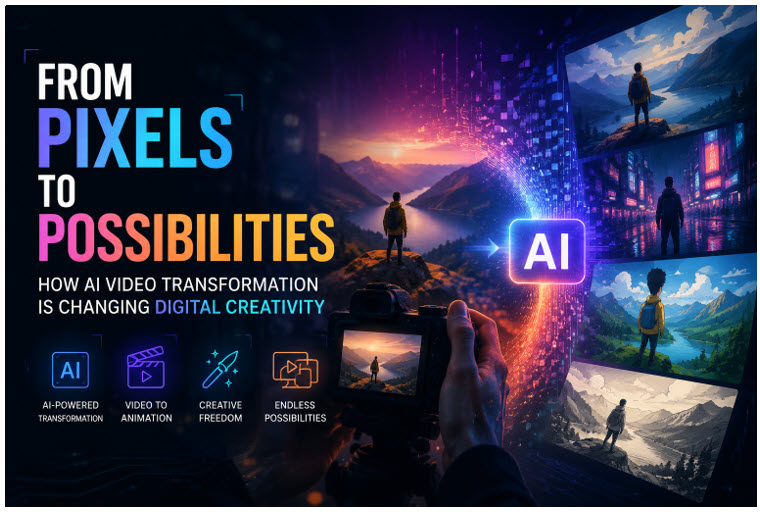
I've been watching the web reinvent itself for a couple of decades now. Text gave way to images. Images gave way to video. And somewhere along the way, "making a video" stopped meaning "point a camera and hope."
It's shifting again — but not in the direction most people assume.
The interesting question isn't really how we record or cut footage anymore. It's what happens to footage that already exists. A clip shot on a phone can turn into an animated short, a stylized cinematic bit, or something that doesn't resemble the source at all — without rebuilding the thing from a blank timeline.
The engine behind this is AI video transformation.
Here's what surprised me after poking at these tools for a while: the headline feature everyone talks about (AI generating new material from scratch) is the less interesting half. The part that actually shifts how creators work is the ability to take something you already shot, let the model understand it, and push it somewhere you didn't budget for.
What Is AI Video Transformation?
First-time users tend to file these tools under "fancy filters." I get why. The surface looks similar — drop in a video, get a different-looking video out. But that framing skips the actual mechanics.
Old-school editing is hands-on almost by definition. You live on a timeline. You keyframe. You stack effects one at a time and pray the render holds.
|
Old-school editing |
AI video transformation |
|
You push every parameter by hand |
The model reads the scene and proposes a re-render |
|
Effects layered frame-adjacent |
Content reinterpreted, not just decorated |
|
Steep technical curve |
Approachable enough to experiment with in an afternoon |
|
Tries to perfect what's there |
Asks "what else could this become?" |
The distinction that matters: the model isn't stamping an effect on top. It's parsing what's in the frame — people, objects, how things move, how scenes are cut together, the overall look — and rebuilding the visual experience while keeping the original idea legible.
The platform I kept coming back to here is GoEnhance AI, a video to animation converter built specifically for turning existing footage into different visual styles, including animation, without requiring you to learn traditional animation production first.
What sold me on this category isn't output quality alone (though that's climbed fast). It's iteration speed. You can throw the same clip at four or five directions in an evening and only commit resources to the one that actually lands.
Video to Animation Converter: Making Animation More Accessible
Animation has a reputation problem. It's treated as the serious, expensive cousin of regular video — the thing that needs a studio, a budget, and someone who's spent ten thousand hours in After Effects.
That gap is closing fast.
A video to animation converter re-skins ordinary footage into animated visuals while holding onto the stuff that matters: the motion, the framing, the emotional beat of the original take. You're not losing the clip. You're changing its identity.
I've watched this play out across a handful of use cases, and the transformations turn out less "cosmetic" than you'd guess:
● Footage of someone walking through a city becomes an animated character piece, gait and street rhythm intact.
● A travel reel turns into an illustrated story where the cuts still land where the original did.
● A product demo stops being a product demo and becomes marketing animation that actually holds attention.
● Personal clips become something closer to art — the kind of thing people want to rewatch.
That opens doors for more than one kind of creator.
Solo creators. One person with a laptop can now explore animation directions that used to demand a small team. The bottleneck moves from "can I produce this?" to "do I have a taste for this?"
Marketing teams. Brands stop shipping one cut per campaign and start shipping variations — platform-specific, audience-specific — without multiplying the production cost each time.
Educators and trainers. Lecture footage that nobody finishes gets a visual layer that keeps people watching. The lesson stays. The packaging changes.
The pattern underneath all three: animation is drifting away from being gated by production muscle. The hard part is becoming creative direction, not execution.
How Video-to-Video Generation Changes Content Creation
There's a related thread here that's easy to confuse with the above: video-to-video generation.
People hear "video-to-video" and picture a filter. It's not. A filter is a fixed recipe — apply, done. A video-to-video generator reads the source and offers a new interpretation of it.
The model looks at what's on screen, how objects are moving, how the scenes are structured, and what style you're after — then it re-renders. The result isn't your footage with a coat of paint. It's a new argument about your footage.
That unlocks experiments that used to live behind a wall of complicated editing:
● restyling into a specific artistic idiom
● pushing footage toward a cinematic register it never had
● swapping visual themes to test which one resonates
● going somewhere the original clip never implied at all
If you want to see what this looks like in practice, the video to video generator over at GoEnhance is a decent reference point — it shows the transformation-of-existing-footage angle rather than the text-prompt-to-video angle that gets all the press.
Here's the shift worth sitting with: videos are starting to behave like flexible creative material rather than finished files. That sounds small. It isn't.
Why Transformable Media Could Shape the Future of the Web
The web has a habit of rewriting itself around whichever medium got cheaper to produce.
Blogging made publishing free. Social networks made distribution free. Short video made attention-scale production nearly free. Each time, the bottleneck moved — and a pile of new formats showed up.
AI video transformation feels like the next tick of that same clock.
My read on why it's getting traction: it lines up with how creators actually work, not how the marketing decks say they work. Most creators aren't stuck for ideas. They're stuck because turning an idea into polished visual content is slow, and they've already shot a hundred clips that are sitting unused in a folder somewhere.
AI reframes the math.
The question stops being "how do I produce another video?" and starts being "how many different things can I spin out of this one clip?"
A single piece of footage can branch into an animated cut, a branded asset, a social variation, a narrative experiment. The source asset gets more valuable the more it can become. That's the part I find genuinely interesting — not the generation, the multiplication.
The Changing Skill Set for Creators in the AI Era
None of this means craft is dead. It means the specific crafts that carried the most weight are shifting.
A decade ago, a creator might spend years getting fluent in complicated production software. That's still valuable. But creative judgment, taste, and storytelling instinct are catching up in market value — sometimes overtaking raw technical fluency.
|
Then |
Now-ish |
|
Master the toolchain |
Have the idea, then direct the toolchain |
|
Execute every detail by hand |
Set up the workflow, then guide it |
|
Polish frame by frame |
Decide which frames are worth polishing |
|
Technical execution |
Taste and direction |
The creators who'll do best here aren't picking a side. They're the ones who can speak both languages — technical enough to steer the tools, human enough to know which result actually lands with an audience.
The Future of AI-Powered Video Creation
My honest guess: AI video transformation ends up as wallpaper. Not in a bad way — in the way that "layers" or "non-destructive editing" became wallpaper. It just turns into how people work, to the point that nobody names it anymore.
When that happens, the mental model shifts too. A video stops being a finished product and starts being a starting point — something that can fork into formats we haven't standardized yet, tuned for audiences and platforms that don't all want the same cut.
The future of video creation probably doesn't begin with an empty timeline. It begins with something that already exists and the question of what else it could be.
AI isn't only making video production faster. It's widening the set of things a creator can seriously imagine.
