
AI Marketing Vocabulary: The New Words Marketers Use and How to Use Them Right
Walk into any marketing meeting today, and you will hear vocabulary that did not exist in the team handbook three years ago.
There are some great online articles covering the top strategies for putting AI to work across campaigns, but far fewer pause to define terms like prompt engineering, RAG layers, hallucinations, agents, and embeddings; terms on which those strategies are built.
Using the wrong word in front of a client or an executive could cost you credibility, even when the underlying work is solid, so let this piece serve as your working glossary. Below are the terms most likely to come up in your next brief and what they actually mean.
Core Generative-AI Terms
These are the words showing up in almost every modern marketing conversation, and they are the ones most often used loosely.
· Large Language Model (LLM): The underlying system powering ChatGPT, Claude, or Gemini, that predicts text based on patterns learned from massive datasets. You might think of an LLM as "the AI," but it is in fact just one specific type of model.
· Generative AI: A broader category covering any model that produces new content, whether that is text, images, audio, or video. All LLMs are generative AI, but not all generative AI is an LLM.
· Prompt engineering: The craft of writing instructions that get a model to produce useful output. In marketing, this has become a skill on par with brief-writing.
· Hallucination: This is when a model produces something that sounds confident but is factually wrong. Simply saying "the AI lied" is sloppy because lying implies intent, which LLMs do not possess.
· Fine-tuning: Adjusting a pre-trained model on your own data so it speaks in your brand voice or knows your product catalog. This is different from simply giving the model a long prompt with examples.
· Retrieval-Augmented Generation (RAG): A setup that lets a model look up information from your own documents before answering, rather than relying only on its training data. Most "AI search" or "ask our knowledge base" features that marketers are shipping right now are RAG under the hood.
If you only commit six terms to memory, make them these.
Other Important Terms
A few terms are less buzzy but increasingly essential as marketing leaders are asked harder questions about how their AI tools actually work.
· Multimodal: A model that can process more than one kind of input or output, like text + images, for instance, or audio + video. Most flagship models released through 2026 are multimodal by default, and creative briefs are starting to assume this without spelling it out.
· Synthetic content: AI-generated media: images, video, audio, voice clones. This is the term that regulators and major platforms have largely settled on for disclosure rules, so if your team is producing AI imagery for paid social or display, expect "synthetic content" to appear in the policy you will eventually be asked to comply with.
· Vector embeddings: A way of turning words or behaviors into numerical representations that capture meaning. You probably will not say this in a creative review, but understanding that your "smart recommendations" or "AI search" feature runs on embeddings helps you ask sharper questions of your engineering team.
· Zero- and first-party data: Not new, but newly central. As third-party cookies continue to wind down, AI-driven personalization is only as good as the proprietary data feeding it, and first-party data is essential to delivering effective personalized experiences.
· Agentic AI: An agent is a system that can take multi-step actions toward a goal, rather than just responding to a single prompt. A chatbot that answers questions is not an agent, but a system that drafts an email, checks a calendar, books the meeting, and updates the CRM is moving toward one. Misusing this term in front of a technical buyer is a fast way to lose the room.
Why the Vocabulary Question Is Bigger Than It Looks
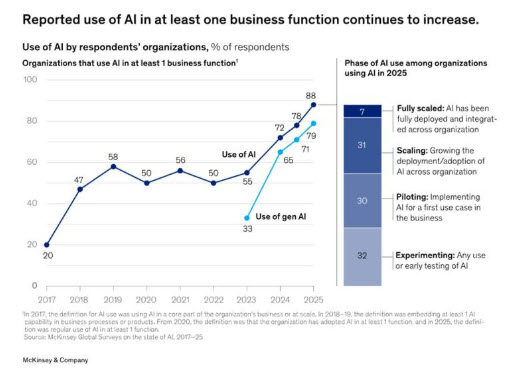
Adoption is no longer the story, with almost 90% of organizations now using AI in at least one business function. Marketing and sales, in particular, are consistently named among the leading adopters. The conversation has moved to a harder question: what exactly are we doing, and what do we call it?
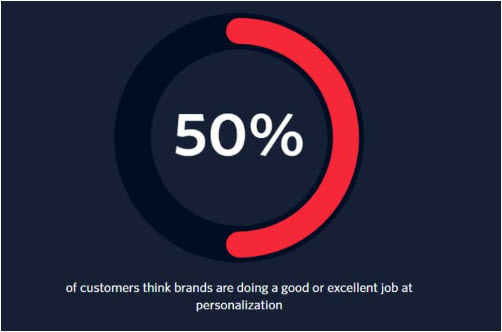
When the words are fuzzy, the work gets fuzzy. A creative director asking for more personalization may picture dynamic email subject lines, while the data team may interpret that as a need to build a predictive model from scratch.
Both interpretations are valid, but confusing them costs real time and budget, so it helps to have a pocket dictionary open in another tab the next time someone drops "agentic" into a Slack channel without explanation.
