
5 Questions to Ask a VAPT Provider Before You Sign the Contract
Getting the right VAPT provider is not just sheer luck. A lot of investigation, scrutiny and a knack of being a detective goes behind the scenes of picking the right one.
Asking relevant and especially the right kind of relevant questions is what will land you the correct provider. VAPT engagement is not merely about providers with flashy certificates or the one that fits your budget range.
Although those are relevant questions, but real investigation revolves around the 5 Rs which is the provider’s preferred Roadmap, Reporting quality, Remediation policies, Regulatory compliance and Result metrics.
This is because these factors shed light not only their on-paper effectiveness but also on-field execution.
So, put on your detective coat and let’s unpack the relevant 5R questionnaire to ask your VAPT provider before you sign the contract.
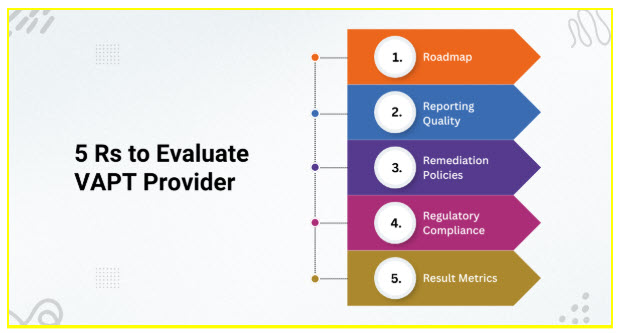
1. The Roadmap - What Is Your Approach?
When meeting your prospective VAPT provider, one of the first and foremost questions that you should ask should be regarding their standard methodology and approach.
Ask them: What is your approach towards the assessment? Learn about their reconnaissance, vulnerability identification and exploitation strategies. Analyse whether they tailor their assessments around business-specific risks.
Another factor is checking if they rely solely on automated scanning. It is important to keep in mind that automated scanning can detect known vulnerabilities, but they often bypass logic flaws, privilege escalation opportunities and interlinked paths that experts unravel manually.
It is your right to know the methods they apply to simulate realistic attack scenarios and their prioritization of infrastructure, applications and threat exposure. They should be able to mould their strategies according to unique organization’s requirements rather than having a “one-method-fits-all” mindset.
Their preferred methodology can serve as the deciding factor as it reveals the depth, reliability and relevance of their VAPT approach.
2. The Reporting Quality – How Will Your Report Benefit Us?
A detailed report can enhance the benefits of the conducted assessment, or it can be just another document stored and neglected. The fate lies in the hands of the provider.
After asking about their approach, follow-up with this question: How will your post assessment report benefit us? Or What insights does your report include?
A report that simply reads like a non-actionable preview of the assessment is of no use. An effective report should serve as a to-do list for security teams. It should be able to translate technical insights into an action plan to strengthen security.
If possible, ask for a sample report to see whether the presentation leans towards a mere preview or an insightful action-plan. An action-focused report consists of executive summaries for leadership, technical details for IT teams, severity rankings, business impact analysis etc.
Also notice on which basis vulnerabilities are categorised and if they include a contextual risk evaluation instead of generic severity scoring.
The best providers consider reporting as a decision-making tool. They help plan an adequate strategy that fixes issues from most dangerous to least.
3. The Remediation Policy – What Happens After the Remediation Phase?
News flash: Not all VAPT providers offer a retest to validate the security of the measures adopted as per remediation guidance. Many organisations are under the illusion that a retest is always followed by the remediation phase.
To avoid being under the wrong impression, always ask: What happens after the remediation phase? Do you offer a retest or end the engagement process?
Retesting is an essential stage of the VAPT assessment because it confirms the validity of the new measures that were incorporated based on the provided remedial guidance. What if the new methodology model is fragile and incompetent in the face of threats?
Also obtain information on the number of validation cycles included and at what number additional costs are charged. Gain clarity on the retesting timeline and if the target points of the retest include a broader regression or exclusive variables only.
An effective retest should verify that detected issues are fully addressed while ensuring that the remediation hasn’t turned out to be harmful instead of helpful by introducing new risks.
4. Regulatory Compliance – Does Your VAPT Assessment Align with Regulatory Compliance and Industry Requirements?
VAPT assessment or any kind of cybersecurity service for that matter, go beyond safety and strengthening of systems. Ensuring security while also being mindful of regulatory compliance and industry requirements is the real deal.
Hence, as a responsible organisation, you must confirm compliance requirements before finalising any provider. Your next question after approach, reporting and remediation should be: Does your VAPT assessment align with regulatory compliance and industry requirements?
Educate the providers on your framework, contractual obligations or regional security expectations and see whether they qualify to be a regulatory match for your organization or not.
Scan their portfolio for previous experience supporting compliance objectives and if their reports are worthy of being submitted for audit approvals.
Tailoring the assessment strategy around regulatory compliance influences testing scope, data handling procedures, reporting formats and remediation timelines. A provider that is well acquainted with compliance standards can help businesses stay on-point with industry expectations and improve audit-readiness.
5. The Result Metrics - What’s Your Definition of Success?
Yes, it sounds philosophical but, in this context, we are asking how they define the success of the VAPT engagement.
Just like everyone’s definition of success, VAPT providers have a different definition too. Therefore, it’s better to just ask: What’s your definition of success? What are your indicators of a successful VAPT engagement?
Study their interpretation of engagement effectiveness and their trusted metrics to define value of the assessment.
Strong providers track indicators like vulnerabilities discovered, remediation progress, decrease in attack surface, resolved issues and overall enhancement of the security posture.
This question reveals the objective of the provider behind the evaluation. If providers claim success in terms of reduced organizational risk and not the number of testing hours, it increases the likeliness of gaining long-term value from the VAPT assessment.
Knowing the provider’s definition of success for a VAPT engagement saves you from unrealistic expectations and disagreements post assessment.
Conclusion: Choosing the Right VAPT Providers
Now that you have understood the 5R questionnaire for your future VAPT provider, don’t shake hands with the provider immediately after discussing the budget range or simply being impressed by their certifications.
The right decision is rarely ever backed by comparing proposals and credentials but rather from asking the right questions.
Evaluating the approach, reporting, remediation, regulatory and success metric criteria can help organizations look beyond surface-level comparisons. Select a partner capable of driving meaningful security results like CyberNX who not only detects weaknesses in the system but also builds stronger and resilient defences over time.
